A wormhole is a shortcut that general relativity allows: a throat joining two distant places, or two universes. Nobody has ever seen one, and keeping one open would take a kind of matter nobody knows how to gather. But if one existed, we know exactly how it would bend light. This one uses the family of wormhole shapes designed for the film Interstellar, with the film's 2 km wide throat, rendered by tracing real light rays through its curved space. Fly a ship through it and watch our sky bend and another sky take over.
What would a wormhole look like?
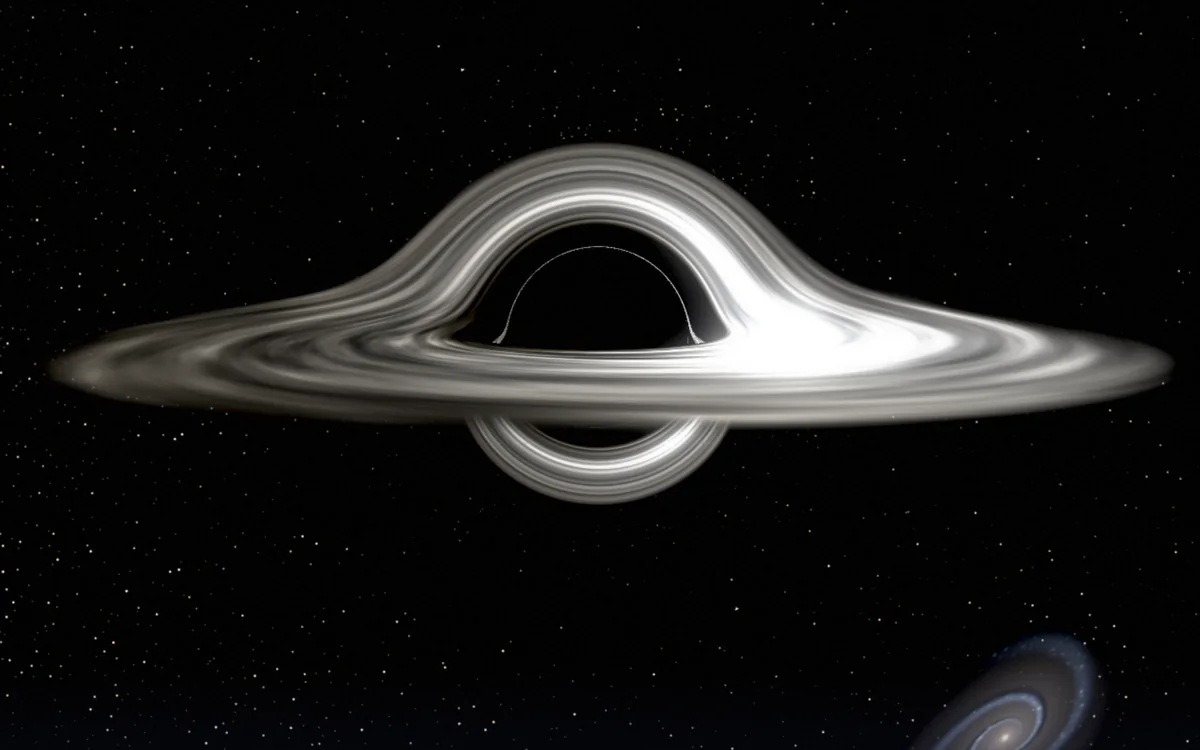
Not like a hole, and not like a funnel. Seen from outside, a wormhole mouth is a sphere, and inside that sphere you see the sky of the place it leads to. Light from that far sky entered the other mouth, crossed the throat and came out toward you. All of the far sky fits inside the sphere: its complete picture fills the middle, out to about half the sphere's radius, and the thin rings near the edge are extra copies, carried by light that wound around the throat before leaving.
Our wormhole has a throat 2 km across, the size chosen for Interstellar, and a tunnel 2 km long. From 6 km away its mouth spans about 20 degrees of your sky, nearly forty times the width of the full Moon.
sin αm = ρ / r angular radius of the mouth · ρ = throat radius, 2πr = the circle through youWhy does the light bend around it?
Space itself is curved around the throat, and light follows the straightest path that curved space allows. Rays aimed inside the rim pass through; rays aimed just outside swing around the throat and come back to our side. That is why a galaxy hidden right behind the wormhole shows up as a ring of light, an Einstein ring, and why Saturn appears twice. Open the flare and the bending grows: a ray aimed 1.5 km off-centre is bent 39.4° here, 5.4° by Interstellar's sharper flare.
The Funnel view draws a slice of this curved space as a surface. The up-down direction of that drawing does not exist, but the light paths on it are exact. One surprise: around a star, half the bending of light comes from curved space and half from slowed time. This wormhole has only the first half. Its clocks run normally, and it pulls on nothing.
ds² = −c²dt² + dℓ² + r(ℓ)² dΩ² no time warp: only space is curved r(ℓ) = ρ + M [x atan x − ½ ln(1 + x²)], x = 2(|ℓ| − a)/(πM) the Double Negative shapeWhat is it like to fly through?
As you approach, the sphere grows and the far sky takes over more of your view: 1.6 % of your sky at 4 km from the mouth, exactly half inside the tunnel, 98 % once you are 4 km out on the other side. Look back and home has become the sphere. The trip runs in real time at 2 km/s, slow for a spacecraft, and speed matters: crossing the curved flare stretches your body sideways in proportion to your speed squared, about 1 g here for a 2 m tall person, 95 g at 20 km/s.
There is no horizon and no singularity, so you can always fly back. When the Interstellar team rendered such a trip, the film-makers found it looked like a camera zoom, so the film layered artistic effects on top.
Δa = v² (r″/r) ξ sideways stretch on a body ξ tall at speed v · r″/r = 4/(π²Mρ) at the mouthCould a wormhole exist?
General relativity allows wormholes, but none has ever been observed and nobody knows how one could form. Holding a throat open needs "exotic" matter: matter that, seen from some moving viewpoints, has negative energy density. The throat must also carry an enormous tension, about 5 × 10³⁶ pascals for our 1 km radius, more than the crushing pressure at the centre of a heavy neutron star.
Quantum physics does allow small patches of negative energy, as in the Casimir effect between two metal plates. But Ford and Roman argued that its rules then limit a static wormhole to barely more than the Planck size, or to negative energy packed in an extremely thin shell. So this is a thought experiment: a shape designed for a film, rendered with the real equations of light.
τ = c⁴ / (8πGρ²) tension at the throat · 4.8 × 10³⁶ Pa for ρ = 1 kmThe numbers
| Quantity | Meaning | Value |
|---|---|---|
| Throat radius ρ | circumference ÷ 2π at the narrowest point (Interstellar's choice); circle 6.28 km | 1km |
| Tunnel length 2a | the straight part between the two mouths | 2km |
| Flare W | width over which the mouth turns from vertical to 45° (0.05–1 km) | 0.5km |
| Mouth from 6 km out | angular size of the sphere | 19.8° |
| Einstein ring there | radius of the ring of the galaxy behind | 21.7° |
| Saturn | true direction / main image / copy, from the centre | 25.2 / 36.5 / 14.8° |
| Bending at 1.5 km | a ray aimed 1.5 km off-centre (impact parameter), flare 0.5 km | 39.4° |
| Far-away bending | half of a star's: only space is curved | 2M/b |
| Far sky inside the tunnel | share of your sky | 50% |
| Ship speed | real time on screen | 2km/s |
| Sideways stretch | at the flare, 2 m body, 2 km/s | 0.95g |
| Throat tension | needed to hold it open (Morris & Thorne) | 4.8 × 10³⁶Pa |
| Clock rate | anywhere, relative to far away | 1.000× |
What's simplified
- A designed shape. The Double Negative shape was chosen for the film to look good, not derived from any known matter; any matter that could hold it open is unknown (and its exotic part, as written, extends far from the throat). Our tunnel is 2 km long; the film's was 200 times shorter.
- No gravity. The film's version adds a weak pull (|Φ| ≲ 10⁻¹²) so the ship's approach could curve around it; we leave it out: it changes nothing visible.
- Static and stable by assumption. Real wormholes, if any, might collapse; stability is not modelled.
- Skies are imagined. Our side is an artist's impression of Saturn's neighbourhood; the far universe is invented, with a galaxy placed behind the wormhole on each side so both Einstein rings show. Saturn is treated as infinitely far away (its parallax over the whole trip is 0.001°). Relative brightnesses are art-directed: from Saturn the real Sun would be about a hundred million times brighter than the brightest star, and would blind the view.
- Ray optics, no waves. Diffraction is ignored (visible light's wavelength is billions of times smaller than the throat); brightness follows surface-brightness conservation, and point stars stay points, brightened by the magnification (capped at 30 times).
- No aberration or Doppler. At 2 km/s they shift the view by 1.4″, far below a pixel.
- Rim averaging. The infinitely many thin copies near the rim are blended once they are thinner than a pixel: each pixel shows the sky averaged along the strip its copies come from (a great circle through the travel axis). The true blend would favour the outermost copy; at that size it makes no visible difference. Near and inside the tunnel, where the copies fill a wide band of the view, they are also blurred along the direction they are squeezed, over up to eight pixels, and reach that strip average sooner: drawn pixel-sharp, they read as a curtain of hard streaks.
- The funnel adds a fake dimension. Lengths on it are true; its height direction is a drawing aid.
- The ship is not to scale. On the funnel it is drawn tens of times too big (at least twelve times), so you can see it and grab it.
Myths
Sources
- James, von Tunzelmann, Franklin & Thorne (2015), Visualizing Interstellar's Wormhole, Am. J. Phys. 83, 486 — arXiv
- Lobo (2016), From the Flamm–Einstein–Rosen bridge to the modern renaissance of traversable wormholes — arXiv
- Nakajima & Asada (2012), Deflection angle of light in an Ellis wormhole geometry, Phys. Rev. D 85, 107501 — arXiv
- Ford & Roman (1996), Quantum field theory constrains traversable wormhole geometries, Phys. Rev. D 53, 5496 — arXiv
- Kuhfittig (2020), Accounting for the large radial tension in Morris–Thorne wormholes — arXiv
- Chronology protection conjecture (Hawking 1992) — Wikipedia
Cited through those: Morris & Thorne (1988), Am. J. Phys. 56, 395; Morris, Thorne & Yurtsever (1988), Phys. Rev. Lett. 61, 1446; Ellis (1973), J. Math. Phys. 14, 104; Thorne, The Science of Interstellar (2014).